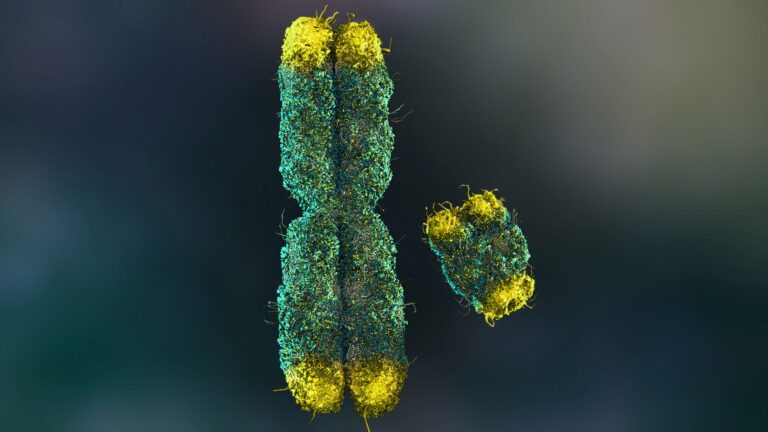
Key Takeaway: A comprehensive review published in Science suggests that the X and Y chromosomes within the nucleus of every cell shape our aging process independently of circulating sex hormones. In aging men, leukocytes that lose the Y chromosome appear to drive myocardial fibrosis and heart failure. In women, a second X chromosome that remains partially active bolsters immune defense while concurrently elevating the risk of developing specific autoimmune diseases.
An Inheritance Written in Every Cell
Picture two septuagenarian siblings sitting across from you in clinic—a sister and a brother. They grew up under the same roof, nourished at the same dinner table. Yet statistically, the sister is far more likely to outlive her brother, and this survival advantage is not merely driven by the endocrine milieu coursing through their vascular systems. The roots of this divergence are encoded within the nucleus of virtually every cell they possess.
For much of the past century, physicians attributed the longevity gap between men and women almost entirely to hormones. Estrogen was heralded as cardioprotective, whereas testosterone was blamed for risk-taking behaviors and premature atherogenesis. These assumptions were not wholly groundless; however, they overlooked a fundamental piece of the puzzle. A state-of-the-art review published in the journal Science illuminates this missing link: sex chromosomes themselves—typically XX in females and XY in males—exert direct control over the cellular dynamics of aging.
How the Researchers Decoupled the Biology
Because this paper is a comprehensive review rather than a single clinical trial, there is no single patient cohort to report. Instead, the authors meticulously synthesized and weighed evidence spanning cytogenetics, functional laboratory assays, genetically engineered animal models, and massive population biobanks. Their primary conclusion is that sex chromosomes exert “cell-autonomous” effects on aging and lifespan. In simpler terms: regardless of which hormonal tides bathe a cell, its intrinsic chromosomal architecture dictates its biological behavior across time[1].
Disentangling this cellular autonomy from systemic endocrine influence without surgical or pharmacological confounding represented one of medicine’s most formidable methodological hurdles. Researchers breached this impasse using elegantly engineered mammalian models. Specifically, the Four Core Genotypes (FCG) model—which translocates the testis-determining Sry gene from the Y chromosome onto an autosome—generates XX and XY mice with either ovaries or testes. This enabled investigators to cleanly decouple the chromosomal constitution from the gonadal phenotype for the first time. In humans, sex chromosome aneuploidies such as Turner (45,X) and Klinefelter (47,XXY) syndromes, alongside monumental population resources like the UK Biobank comprising hundreds of thousands of individuals, have provided an unprecedented genetic window into the clinical ramifications of X-gene dosage and somatic Y chromosome loss.
Key Findings
The review zeroes in on three critical biological phenomena capable of reshaping the natural history of human disease:
- Mosaic loss of chromosome Y (LOY): As men age, a subset of hematopoietic cells entirely sheds the Y chromosome. The term “mosaic” denotes that this event affects only certain lineages, creating a genetically heterogeneous cellular tapestry. In aging men, this leukocyte deficiency correlates directly with progressive tissue scarring (cardiac fibrosis), abrupt decompensation in heart failure, and premature all-cause mortality.
- Incomplete X-chromosome inactivation: Female cells ordinarily silence one of their two X chromosomes. However, this transcriptional silencing is neither absolute nor ubiquitous; consequently, specific genes escape inactivation and continue to be transcribed from both parental alleles.
- X-chromosome reactivation: Under defined physiological or pathological conditions, silenced regions of the inactive X chromosome can undergo transcriptional reawakening.
The relationship between LOY and shortened survival has been progressively elucidated over the past decade. A landmark 2014 Swedish investigation first correlated hematopoietic LOY with reduced longevity and elevated cancer incidence in men[2]. In 2022, mechanistic murine studies proved that Y-deficient hematopoietic stem cells directly orchestrate cardiac fibrosis and precipitous…
ŞA
Medically reviewed by
Dr. Şekip Altunkan
Dr. Şekip Altunkan is an internal medicine specialist with extensive clinical experience. He trained at Hacettepe University Faculty of Medicine and later served as an Associate Professor in Internal Medicine. He founded and led the Metropol Internal Medicine and Hypertension Clinic in Ankara, pioneering non-invasive Electron Beam Tomography (EBT) cardiac imaging, arterial-stiffness measurement, and nationwide Holter monitoring. He currently practices at his private clinic in Ankara, focusing on hypertension, vascular health, cholesterol, diabetes and heart disease. He has published widely in national and international journals, serves as a peer reviewer for several international journals, and is the author of the book "Questions and Answers on Hypertension."