11 Points Lower, 61% Fewer Brain Bleeds
Key Takeaway: For individuals who have suffered a stroke due to brain hemorrhage, intensive blood pressure lowering—achieving a systolic reduction of about 11 mmHg—decreases the risk of a second stroke by 38% and, remarkably, the risk of a recurrent brain hemorrhage by 61%. That this benefit materializes within months, not years, establishes this intervention as one of the most potent and fast-acting treatments in stroke medicine.
A Second Chance, A Call to Action
For patients who have survived a hemorrhagic stroke—an intracerebral hemorrhage—the ensuing weeks and months are shadowed by a grim statistic: left untreated, approximately one in five will suffer a second stroke within five years[2]. This subsequent event is often fatal or devastating. Yet, among all the medications, rehabilitation protocols, and lifestyle changes a patient can adopt, one intervention stands out for its immense protective power: aggressive blood pressure lowering. A new, definitive analysis pooling individual patient data from four randomized controlled trials now quantifies this power with unprecedented clarity, and the resulting figures put a decisive end to the long-standing debate over just how low to go.
Study Methodology
This was not a single trial but a more rigorous methodology: a meta-analysis based on individual participant data, considered the gold standard of evidence synthesis[3]. Instead of simply averaging published results, the researchers obtained the raw, patient-level data from four randomized controlled trials involving a total of 2,944 participants who had previously experienced an intracerebral hemorrhage (ICH), the deadliest type of stroke. In each study, patients were randomized to either intensive blood pressure-lowering therapy or a less aggressive approach. The fundamental question was straightforward: does lowering blood pressure more prevent a second stroke?
The Findings
The results were clear and unequivocal. Intensive blood pressure-lowering therapy reduced the risk of a first recurrent stroke of any type by 38% (hazard ratio 0.62, 95% confidence interval 0.48–0.80)[1]. But that headline figure tells only the beginning of the story. When the researchers specifically examined recurrent intracerebral hemorrhage—the very type of stroke these patients had already suffered—they found the risk reduction was a remarkable 61% (HR 0.39, 95% CI 0.26–0.59). The average difference in systolic blood pressure between the intensive and standard treatment groups was 11.2 mmHg, demonstrating that a modest pharmacological effort yielded massive clinical dividends. Perhaps the most compelling finding was the speed at which the benefit emerged: it was estimated to take just 6.1 months to achieve a 1% reduction in absolute risk. In practical terms, this means that for every 100 patients receiving intensive treatment, one additional stroke was prevented within about six months. This effect was consistent across all subgroups examined, including patients with different bleed locations, ages, and baseline blood pressures.
The Mechanism: Why Blood Pressure Matters So Much After a Brain Hemorrhage
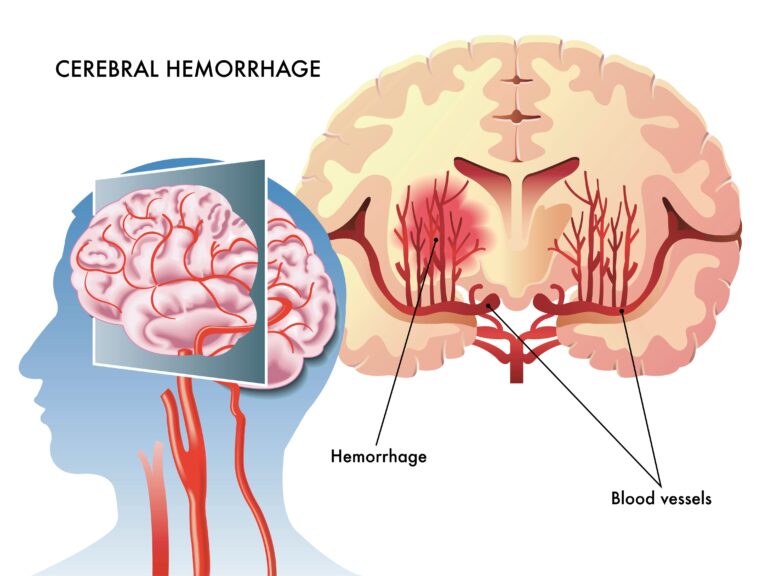
To understand why these results are so dramatic, it helps to know what causes an intracerebral hemorrhage in the first place. The most common culprit is hypertensive small vessel disease, where years of high blood pressure inflict continuous damage on the small, perforating arteries deep within the brain. Over time, these vessels develop a condition called lipohyalinosis, where the smooth muscle in their walls is replaced by a glassy, brittle material, making them prone to rupture under pressure[4]. In some patients, particularly older individuals, a process known as cerebral amyloid angiopathy occurs, where a protein called amyloid builds up in the walls of cortical blood vessels, weakening them further[5].
Once a person has had one bleed, the remaining small vessels are a landscape of damaged infrastructure. They are stiffened, fragile, and primed for re-injury. High blood pressure acts as a constant mechanical stressor on these weakened vessels. Lowering systolic pressure by just 10–15 mmHg dramatically reduces the likelihood of rupture by decreasing the transmural pressure gradient across these weakened arteriolar walls. At the same time, it preserves remaining vascular integrity by slowing the progression of further hypertensive vasculopathy[6]. This is why the risk reduction for recurrent ICH (61%) is so much greater than for ischemic stroke; the mechanism of protection directly targets the pathology that caused the initial bleed.
Furthermore, emerging evidence suggests that it’s not just the average level of blood pressure but also its variability that contributes to hemorrhagic risk[7]. Intensive treatment strategies that smooth out blood pressure fluctuations may therefore offer a secondary layer of protection beyond just lowering the mean value.
Limitations to Consider
Like any analysis, this one has its limitations. While the meta-analysis of individual participant data is the most robust form of evidence synthesis, the four trials included in the analysis had some differences in their designs, blood pressure targets, and follow-up durations. The total sample of 2,944 patients, while substantial, may have been underpowered to detect differences in rarer outcomes like cardiovascular death or cognitive decline. Additionally, the optimal blood pressure target has not yet been defined; while the analysis shows that lower is better, the question of exactly how low to go remains for future studies to answer. Finally, the risks of intensive blood pressure lowering—such as dizziness, falls, and kidney injury—were not a primary focus of this analysis, and clinicians must carefully weigh these risks in older or frail patients.
Conclusion: Actionable Insights for Patient Care
This analysis should be considered a cornerstone paper for anyone involved in the care of patients who have survived an ICH. The data are now unequivocal: clinical inertia in post-hemorrhage blood pressure management is indefensible. A systolic blood pressure reduction of 11 mmHg—achievable in most patients with a single additional antihypertensive agent—translates to a 38% reduction in the risk of any recurrent stroke and a 61% reduction in the risk of another catastrophic brain hemorrhage. Because the benefit begins to emerge within six months, delays in titrating medications represent a measurable and preventable harm. For patients, the message is equally clear: If you have had a brain hemorrhage, your blood pressure is not just a number on a chart; it is the single most important modifiable determinant of whether you will have another one. Achieving and maintaining a lower target is not an option; it is the most critical thing you can do to protect your brain.
Scientific Sources
- Wang X, et al. Intensive blood pressure lowering after spontaneous intracerebral haemorrhage for secondary stroke prevention (RECAP-ICH): a systematic review and individual participant data meta-analysis. The Lancet. Neurology. 2026;25(9):830-839. PubMed: https://pubmed.ncbi.nlm.nih.gov/42586098/
- Poon MT, et al. Long-term prognosis after intracerebral haemorrhage: systematic review and meta-analysis. J Neurol Neurosurg Psychiatry. 2014. DOI: 10.1136/jnnp-2013-306476
- Riley RD, et al. Individual participant data meta-analysis to examine interactions between treatment effect and participant-level covariates. Stat Med. 2020. DOI: 10.1002/sim.8516
- Fisher CM. Pathological observations in hypertensive cerebral hemorrhage. J Neuropathol Exp Neurol. 1971. DOI: 10.1097/00005072-197107000-00015
- Charidimou A, et al. Cerebral amyloid angiopathy with and without hemorrhage: evidence for different disease phenotypes. Neurology. 2015. DOI: 10.1212/WNL.0000000000001398
- Iadecola C, et al. Hypertension and cerebrovascular dysfunction. Cell Metab. 2009. DOI: 10.1016/j.cmet.2008.03.010
- Rothwell PM, et al. Prognostic significance of visit-to-visit variability, maximum systolic blood pressure, and episodic hypertension. Lancet. 2010. DOI: 10.1016/S0140-6736(10)60308-X
Medically reviewed by
Dr. Şekip Altunkan
Dr. Şekip Altunkan is an internal medicine specialist with extensive clinical experience. He trained at Hacettepe University Faculty of Medicine and later served as an Associate Professor in Internal Medicine. He founded and led the Metropol Internal Medicine and Hypertension Clinic in Ankara, pioneering non-invasive Electron Beam Tomography (EBT) cardiac imaging, arterial-stiffness measurement, and nationwide Holter monitoring. He currently practices at his private clinic in Ankara, focusing on hypertension, vascular health, cholesterol, diabetes and heart disease. He has published widely in national and international journals, serves as a peer reviewer for several international journals, and is the author of the book "Questions and Answers on Hypertension."