The Balance Prescription: Not All Exercises Are Equal
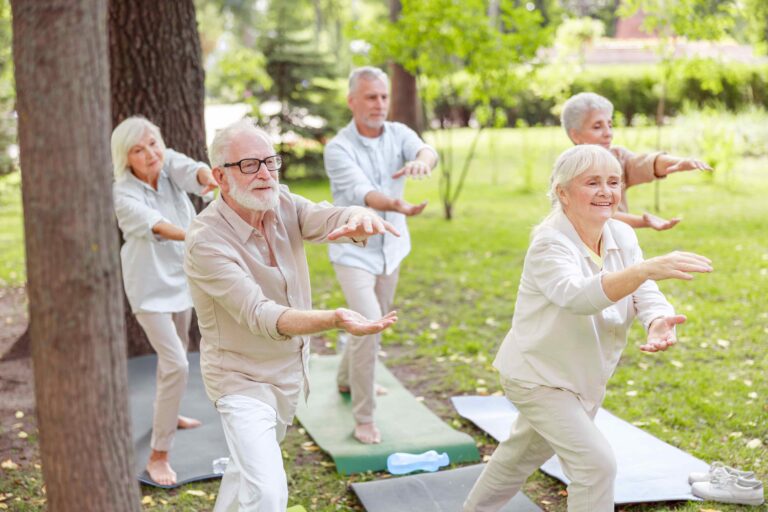
Key Takeaway: A large-scale analysis of 423 randomized trials has revealed that perturbation training, sensory training, dance, and agile stepping exercises provide the greatest benefits for improving balance in older adults. The study determined that different exercise types excel in different domains—such as Tai Chi for overall balance and Pilates for dynamic balance—suggesting that the optimal exercise prescription depends on an individual’s specific risks and circumstances.
The Fall That Changes Everything
For the 33,901 older adults included in a massive, recently published analysis, the type of balance exercise they performed made a far more significant difference than whether they exercised at all. Each year, approximately one in four Americans over the age of 65 experiences a fall, and falls remain the leading cause of injury-related death in this population[2]. A hip fracture, a head injury, or even the fear of falling again can trigger a cascade of lost independence, social isolation, and an accelerated decline in health. Physicians have long advised patients to “stay active” and “work on your balance,” but this advice is as vague as telling someone with high blood pressure to “eat better.” So, which exercises truly make a difference, and for whom?
How the Study Was Conducted
An international team of researchers conducted a systematic review and a Bayesian network meta-analysis. This sophisticated statistical method allows for indirect comparisons between multiple interventions, even when studies directly comparing them do not exist. The researchers pooled data from 423 randomized controlled trials involving 33,901 adults aged 60 and over[1]. These studies covered 19 different types of exercise, ranging from traditional strength training and yoga to lesser-known approaches like perturbation training and sensory manipulation exercises. The investigators evaluated the outcomes across various domains of balance, including overall balance, static balance (standing still on a stable or unstable surface), dynamic balance (maintaining control during movement), and global composite measures.
Key Findings
Of the 19 exercise types examined, 18 improved overall balance compared to inactive control groups. The sole exception was stretching, which showed no significant benefit. However, the magnitude of improvement varied dramatically across exercise types. The top performers for overall balance were perturbation training (Hedges’ g = 0.66), sensory training (0.55), dance (0.54), and agile stepping exercises (0.53). To put these effect sizes in context, a Hedges’ g value above 0.5 is generally considered a moderate effect, meaning the result is clinically meaningful and not trivial.
When the researchers focused on specific domains of balance, this hierarchy shifted. Tai Chi emerged as the best method for global balance, which refers to composite clinical scales that physical therapists use to assess real-world balance capabilities. Perturbation training dominated in static balance outcomes, while Pilates proved to be the most effective for dynamic balance. The study also revealed important context-dependent findings: perturbation training yielded the best results in supervised clinical settings for individuals identified as having a high risk of falling, whereas sensory training was the standout option for home-based exercise programs.
Simply dividing balance into static and dynamic categories leaves the clinical picture incomplete; indeed, the analysis illuminates two more critical dimensions of postural control: “proactive balance,” which involves adjusting body weight before initiating a voluntary step, and “reactive balance,” which engages when we trip. For proactive control, which represents rising from a chair and moving toward a target, agile stepping exercises (AS) and aquatic exercises (AQ) performed equally as the strongest interventions (Hedges’ g = 0.71 for both). In contrast, for reactive balance, the reflexive recovery from an unexpected push, dual-task training (DT) produced the highest point estimate but failed to prove definitive superiority because its confidence interval crossed zero. The interventions that showed statistically significant signals on the reactive side were balance-specific training (BS: 0.69), aquatic exercises (AQ: 0.60), and conventional resistance training (CRT: 0.58). However, the researchers emphasize that these results for reactive balance should be interpreted with caution, as it was measured in only 10 clinical trials.
Why These Exercises Work: The Mechanism of Action
Balance is not a single skill. It is an orchestra of systems—visual, vestibular (inner ear), and proprioceptive (joint and muscle position sensors)—all coordinated in real time by the cerebellum and brainstem[3]. Aging degrades the quality of each of these inputs. Peripheral nerve fibers lose density, reducing proprioceptive acuity in the feet and ankles[4]. The number of vestibular hair cells declines. Reaction times lengthen as central processing slows.
Perturbation training works by intentionally creating unexpected pushes, pulls, or surface shifts, essentially rehearsing the moment a person begins to fall. This trains what neuroscientists call reactive postural responses—the rapid, largely automatic muscle activations that catch you before you hit the ground. Research has shown that even a single session of perturbation training can reduce fall rates in older adults, likely because the nervous system retains a memory of these protective motor patterns for months[5].
Sensory training targets the input side of the equation. Exercises on foam pads, with eyes closed, or on tilting platforms force the brain to recalibrate how it weighs conflicting sensory signals, a process known as sensory reweighting[6]. The broad benefits of Tai Chi likely come from a different pathway: its combination of slow, deliberate weight transfers and a continuous focus of attention trains both the motor and cognitive components of balance simultaneously. Dance adds rhythmic variability and spatial navigation, challenging the brain to adapt to changing movement demands in real time.
The analysis’s dose-response curves point to a paradigm-shifting reality in exercise physiology: improving balance does not require heart-pounding cardio or high metabolic effort. It may seem surprising that the model showed peak adaptation occurring at approximately 2 METs (requiring only twice the energy of resting metabolism, equivalent to a slow walk). However, MET value measures cardiorespiratory load; it does not reflect the “neuromotor challenge” imposed on the cerebellum, proprioceptors, and vestibular nuclei. A slow, precise, and mindful session of perturbation or sensory calibration sends a massive postural error-correction signal to the nervous system without metabolically taxing the muscles. In a balance prescription, therefore, success is driven not by sweating and calorie expenditure, but by the specific task challenge presented to the neuronal circuits.
Noteworthy Limitations
No single study—not even one synthesizing 423 of them—can settle a question permanently. The included trials varied in their duration, intensity, and methods of measuring balance. Many were small, and not all were blinded. The Bayesian network meta-analysis relies on an assumption of transitivity for comparisons across studies, and some exercise categories contained relatively few trials. Publication bias—the tendency for positive results to be published more readily—may also have inflated the effect sizes. Finally, most studies measured balance as a surrogate endpoint rather than tracking actual fall events over time.
When the quality of evidence is examined, a methodological reality stands out: none of the 210 pairwise network comparisons achieved “high certainty” according to GRADE criteria. Only 20.5% of comparisons offered moderate certainty, while a vast majority of 79.5% were of low or very low evidence quality. This is primarily due to the diversity of protocols between studies and the scarcity of direct head-to-head trials. Indeed, when 16 studies with a high risk of bias were excluded from the analysis, the overall effect coefficient for perturbation training dropped from 0.66 to 0.56, and it was surpassed by sensory training in the SUCRA ranking. This serves as a reminder that rather than a single champion exercise, there is a leading “group of interventions” whose effectiveness varies with the clinical situation. Furthermore, spline models indicated that balance gains from exercise are highest around age 60 (g = 0.75) and diminish by age 80 and beyond (g = 0.35), highlighting the need for slower progression and closer supervision in very old age groups.
What These Findings Mean for You
The study’s practical message is refreshingly specific. If you are an older adult concerned about falls, or a family member helping to design an exercise plan, the evidence now supports a tailored approach over generic advice:
- For those at high risk of falling with access to a clinic or gym: Supervised perturbation training offers the greatest overall benefit, directly training the reflexes that prevent a stumble from becoming a fracture.
- For Those at High Fall Risk (A Dramatic Difference): While perturbation training produces a moderate effect in individuals not at risk of falling (g = 0.62), it delivers a massive clinical gain in those with a fall history or at high risk (g = 1.58). However, the safety and efficacy of this method necessitate supervision by an expert physical therapist in a clinical setting (supervised g = 0.73).
- For those exercising at home: Sensory training exercises—such as standing on a pillow with eyes closed—are the most effective option you can do without equipment or supervision.
- For those working independently in a home setting: In home-based applications, sensory training is by far the most potent alternative, with an effect size of 0.88. Interventions like using a foam surface, closing the eyes, or practicing a tandem stance can be integrated into daily life without expensive devices.
- For those seeking a sustainable group activity: Tai Chi and dance both offer powerful, broad-spectrum balance improvements, with the added benefit of social interaction, which independently supports cognitive and emotional health in aging.
- For those wanting to improve movement-based balance: Pilates, with its focus on controlled and fluid transitions, appears to be the optimal method for dynamic stability.
- For those seeking reactive protection and anticipatory stepping: To prepare for tripping over an obstacle while walking, agile stepping (AS) and aquatic resistance exercises (AQ) maximize the ability to rapidly reposition the body’s center of mass (proactive balance g = 0.71).
The days of simply telling patients to “be more active” should be behind us. Balance is a trainable skill, and the type of training matters. Matching the right method to the right person—considering their risk level, environment, and the specific aspect of balance that most needs improvement—transforms a vague recommendation into a precise prescription. This analysis shows that such precision can be the difference between a close call and a life-changing fall.
Scientific Sources
- Wang J, et al. Exercise modalities for overall and domain-specific balance performance in older adults: A systematic review and Bayesian network meta-analysis. Ageing research reviews. 2026;121:103303. PubMed: https://pubmed.ncbi.nlm.nih.gov/42600321/
- Bergen G, et al. Falls and Fall Injuries Among Adults Aged ≥65 Years — United States, 2014. MMWR Morb Mortal Wkly Rep. 2016. DOI: 10.15585/mmwr.mm6537a2
- Horak FB. Postural orientation and equilibrium: what do we need to know about neural control of balance to prevent falls? Age Ageing. 2006. DOI: 10.1093/ageing/afl077
- Shaffer SW, et al. Aging of the somatosensory system: a translational perspective. Phys Ther. 2007. DOI: 10.2522/ptj.20060083
- Pai YC, et al. Inoculation against falls: rapid adaptation by exposures to slips. Arch Phys Med Rehabil. 2010. DOI: 10.1016/j.apmr.2009.10.032
- Peterka RJ. Sensorimotor integration in human postural control. J Neurophysiol. 2002. DOI: 10.1152/jn.2002.88.3.1097
Medically reviewed by
Dr. Şekip Altunkan
Dr. Şekip Altunkan is an internal medicine specialist with extensive clinical experience. He trained at Hacettepe University Faculty of Medicine and later served as an Associate Professor in Internal Medicine. He founded and led the Metropol Internal Medicine and Hypertension Clinic in Ankara, pioneering non-invasive Electron Beam Tomography (EBT) cardiac imaging, arterial-stiffness measurement, and nationwide Holter monitoring. He currently practices at his private clinic in Ankara, focusing on hypertension, vascular health, cholesterol, diabetes and heart disease. He has published widely in national and international journals, serves as a peer reviewer for several international journals, and is the author of the book "Questions and Answers on Hypertension."