The Sensor That Sees What HbA1c Can’t
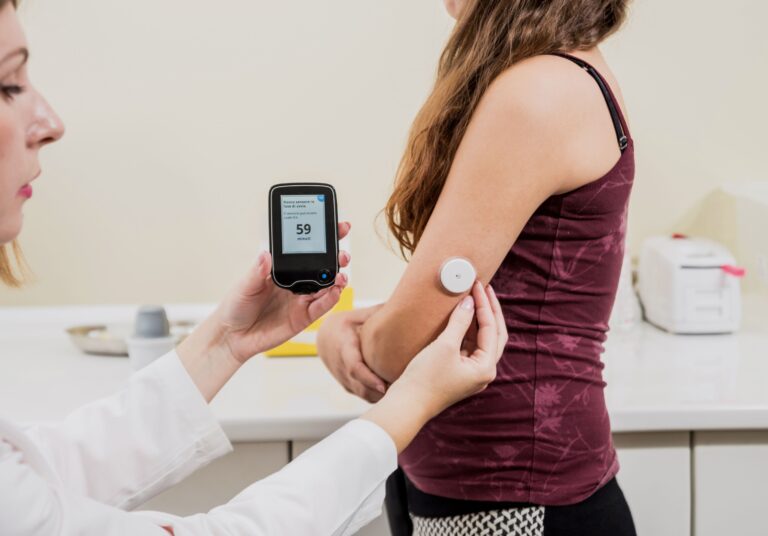
Key Takeaway: In a national study of U.S. veterans with diabetes undergoing dialysis, the use of a continuous glucose monitor (CGM) was associated with a 17% lower risk of death compared to non-use. This finding is particularly significant because standard blood sugar tests like HbA1c are largely unreliable in dialysis patients, positioning CGM as the best available tool to guide treatment in this high-risk group.
A Small Sensor, A Profound Signal
Consider a patient with diabetes whose life depends on three dialysis sessions a week. Their kidneys have failed. Their blood chemistry changes dramatically with each treatment. Their blood sugar fluctuates wildly, sometimes plummeting dangerously during dialysis, other times spiking afterward. And the one lab test their doctor has relied on for decades to gauge long-term glucose control, hemoglobin A1c, is essentially lying to them. Now, imagine that a small adhesive sensor on this patient’s arm, silently measuring glucose levels every few minutes, could be associated with a significantly lower risk of death. A major new study of U.S. veterans suggests exactly that, and the implications could reshape how we care for one of the nation’s most medically fragile populations.
Study Methodology
Researchers drew on national Veterans Affairs (VA) and Medicare administrative data to identify veterans with diabetes undergoing maintenance dialysis. They compared those who initiated continuous glucose monitor (CGM) use to those who did not. To ensure a fair comparison—since CGM users might differ from non-users in important ways—the team employed propensity score matching, a statistical technique that paired patients who were similar in age, comorbidities, medications, and other characteristics, differing only in their use of CGM. This created a carefully balanced cohort of 2,008 patients. The researchers then applied a doubly-adjusted model, layering additional statistical controls on top of this matching to provide an extra safeguard against confounding factors.
Key Findings
In this matched cohort, new CGM use was associated with a 17% reduction in the risk of all-cause mortality (hazard ratio [HR] 0.83, 95% confidence interval 0.75–0.92)[1]. The finding held when the researchers repeated the analysis in a larger cohort of 3,088 patients using multiple imputation—a technique to handle missing data—yielding a consistent hazard ratio of 0.84 (95% CI 0.73–0.96). In practical terms, this could mean fewer deaths over the study period. For a device that weighs less than a coin, that’s a significant signal.
The Underlying Pathophysiology
To understand why CGM might confer a survival advantage in dialysis patients, one must first grasp why managing blood sugar in this group is so challenging. Hemoglobin A1c, the cornerstone of outpatient diabetes management, reflects about 90 days of average glucose exposure by measuring glycated hemoglobin in red blood cells[2]. But dialysis patients are often anemic and receive erythropoiesis-stimulating agents, which accelerate red blood cell turnover. This shortened lifespan of red blood cells means hemoglobin has less time to accumulate glucose, causing the A1c to falsely underestimate true glycemic levels[3]. Iron supplementation and blood transfusions, also common in dialysis patients, further distort the measurement. The result is a clinical blind spot: physicians may believe a patient’s glucose is well-controlled when it is not, or they may undertreat hyperglycemia based on a falsely reassuring lab value.
CGM can bypass this problem entirely. Instead of relying on a surrogate marker tied to red blood cell biology, a CGM sensor directly measures glucose in the interstitial fluid, producing a reading every one to five minutes. This provides a rich, continuous data stream that reveals not just the average glucose but the entire architecture of glycemic variability—the post-meal peaks, the nadirs during and after dialysis sessions, and the overnight fluctuations that fingersticks routinely miss[4]. Glycemic variability itself has been independently associated with cardiovascular events and mortality in dialysis patients[5]. By making these dangerous swings visible in real time, CGM empowers both patients and clinicians to adjust insulin doses, modify dietary choices around dialysis sessions, and intervene before a hypoglycemic event becomes life-threatening.
Hypoglycemia warrants special emphasis. In hemodialysis patients, glucose is cleared from the body across the dialyzer membrane, and the post-dialysis period carries a high risk for low blood sugar. Severe hypoglycemia is linked to cardiac arrhythmias, falls, and sudden death[6]. CGM alarms can alert patients and caregivers to falling glucose levels before symptoms arise, potentially preventing serious events.
Notable Limitations
This study is an observational study, not a randomized controlled trial, so it cannot definitively prove that CGM use causes the reduction in mortality. Patients who opt for CGM may be more engaged in their health, more adherent to their medications, or have better access to care—factors that are difficult to fully account for, even with sophisticated statistical methods. The study population was predominantly male veterans, which may limit the generalizability of the findings to women and non-veteran populations. Additionally, the researchers relied on administrative claims data, which could not capture granular clinical details like specific CGM glucose values, time in range, or what specific clinical decisions were informed by CGM data.
Conclusion: The Implications of These Findings
Despite these caveats, this study represents the strongest evidence to date linking CGM use to improved survival in the dialysis population. For patients with diabetes on dialysis, the message is clear: ask your doctor about continuous glucose monitors. This technology is no longer a luxury for tech-savvy patients with type 1 diabetes and healthy kidneys. It may be an essential tool for those navigating the intersection of kidney failure and disordered glucose metabolism. For clinicians, these data should serve as a wake-up call to seriously reconsider current clinical practice. If CGM is not being discussed with every diabetes patient on dialysis, the question that must be asked is: Why not? And for policymakers and insurers, the findings add urgency to the case for expanding reimbursement criteria. In a population where annual mortality rates routinely exceed 20%, a 17% reduction in mortality risk is not a marginal improvement. It is a signal that demands attention and action.
Scientific Sources
- Narasaki Y, et al. Continuous Glucose Monitoring and Mortality Risk Among U.S. Veterans Receiving Dialysis With Diabetes. Diabetes care. 2026;49(7):1285-1293. PubMed: https://pubmed.ncbi.nlm.nih.gov/42224118/
- Nathan DM, et al. Translating the A1C assay into estimated average glucose values. Diabetes Care. 2008. PMID: 18540046
- Speeckaert M, et al. Are there better alternatives than haemoglobin A1c to estimate glycaemic control in the chronic kidney disease population? Nephrol Dial Transplant. 2014. PMID: 24470517
- Danne T, et al. International consensus on use of continuous glucose monitoring. Diabetes Care. 2017. PMID: 29162583
- Rambod M, et al. Glycosylated hemoglobin, glycemic control, and mortality in hemodialyzed diabetic patients. Kidney Int. 2007. PMID: 17495942
- Katsiki N, et.al.Hypoglycaemia and Cardiovascular Disease Risk in Patients with Diabetes. Curr Pharm Des. 2020. PMID: 32912117
Medically reviewed by
Dr. Şekip Altunkan
Dr. Şekip Altunkan is an internal medicine specialist with extensive clinical experience. He trained at Hacettepe University Faculty of Medicine and later served as an Associate Professor in Internal Medicine. He founded and led the Metropol Internal Medicine and Hypertension Clinic in Ankara, pioneering non-invasive Electron Beam Tomography (EBT) cardiac imaging, arterial-stiffness measurement, and nationwide Holter monitoring. He currently practices at his private clinic in Ankara, focusing on hypertension, vascular health, cholesterol, diabetes and heart disease. He has published widely in national and international journals, serves as a peer reviewer for several international journals, and is the author of the book "Questions and Answers on Hypertension."