#pharmacology_drug_safety

The Andexanet Paradox: Stopping a Bleed, Starting a Clot
Medically Reviewed by Dr. Şekip Altunkan on Nov 14, 2026.
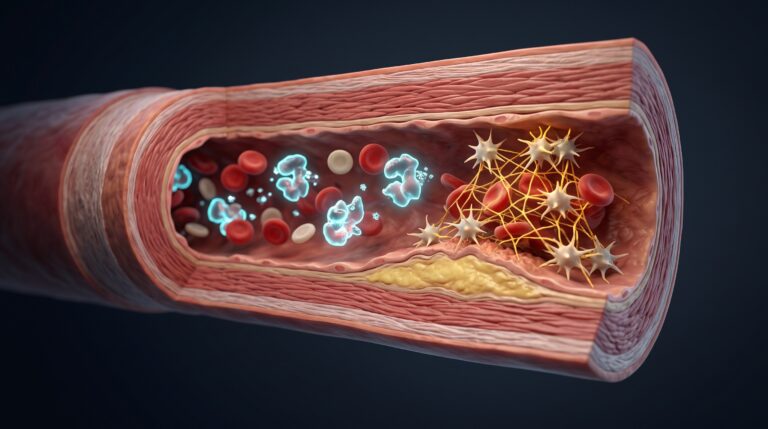
3D cross-section of a brain artery showing decoy proteins binding a blood thinner as a platelet-fibrin clot forms on the wall

Image generated by AI · VitalsDaily

Key Takeaway

In a pooled analysis of 741 patients administered andexanet to reverse factor Xa inhibitor anticoagulants during life-threatening bleeding, thrombosis developed in 10.4% of patients, and 19.8% died. Arterial clots emerged early; this risk surged substantially among individuals with a prior myocardial infarction and those eligible for the high-dose protocol. While patients who developed arterial thrombosis faced a nearly threefold increase in mortality, resuming anticoagulation was associated with lower rates of thrombotic events.

An Antidote Capable of Turning on Its Patient

Consider an 81-year-old retired schoolteacher managed on apixaban for atrial fibrillation. Six years earlier, he suffered a myocardial infarction and underwent coronary stent placement. One Tuesday morning over breakfast, his speech abruptly becomes slurred. An emergency department non-contrast head CT reveals blood pooling within the brain parenchyma. The very anticoagulant meant to safeguard him against an ischemic stroke has transformed into an imminent threat, fueling an acute intracranial hemorrhage.

The clinical team acts without hesitation, administering andexanet alfa—a targeted reversal agent engineered specifically to neutralize oral factor Xa inhibitors such as apixaban and rivaroxaban. A follow-up CT scan the next morning is reassuring: hematoma expansion has halted. Yet on post-treatment day 3, the…

Medically reviewed by

Dr. Şekip Altunkan

Dr. Şekip Altunkan is an internal medicine specialist with extensive clinical experience. He trained at Hacettepe University Faculty of Medicine and later served as an Associate Professor in Internal Medicine. He founded and led the Metropol Internal Medicine and Hypertension Clinic in Ankara, pioneering non-invasive Electron Beam Tomography (EBT) cardiac imaging, arterial-stiffness measurement, and nationwide Holter monitoring. He currently practices at his private clinic in Ankara, focusing on hypertension, vascular health, cholesterol, diabetes and heart disease. He has published widely in national and international journals, serves as a peer reviewer for several international journals, and is the author of the book "Questions and Answers on Hypertension."

Share this article