#percutaneous_coronary_intervention

The Stent That Looked Perfect on the Screen Wasn’t
Medically Reviewed by Dr. Şekip Altunkan on Nov 20, 2026.
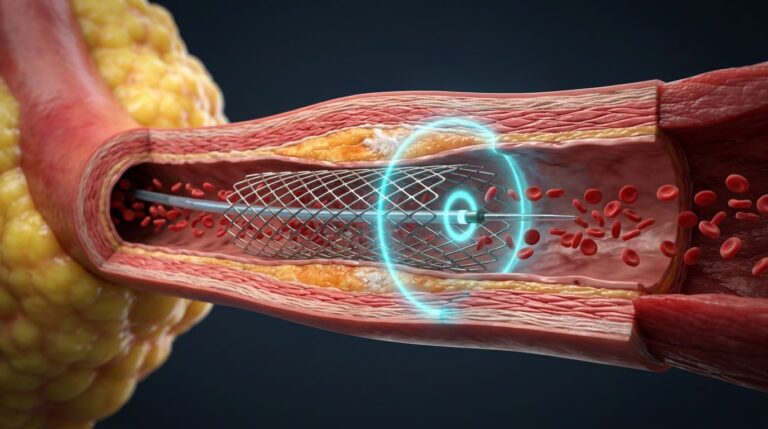
Longitudinal 3D cutaway of a coronary artery showing a deployed stent, fibrocalcific plaque, and a cyan imaging ring at the catheter tip. Illustration: Vitalsdaily

Image generated with AI · VitalsDaily

Key Takeaway

Encompassing 28 randomized controlled trials and 24,634 patients, this meta-analysis demonstrates that intracoronary imaging guidance during stent implantation significantly reduces cardiac death, all-cause mortality, and stent thrombosis compared with angiography alone. Recent neutral trials represented little more than background noise around an otherwise resolute clinical signal; indeed, the Class I guideline recommendation now rests on firmer ground than ever before.

The Shadow on the Screen

On the catheterization laboratory table lies a 67-year-old man with a long, heavily calcified lesion in the proximal left anterior descending (LAD) artery. Following stent deployment, the contrast-filled lumen on the fluoroscopy monitor appears reassuringly smooth, tempting the interventionalist to declare the procedure complete. Yet conventional angiography is, fundamentally, merely a shadowgram. It depicts a two-dimensional, frequently foreshortened silhouette of the contrast column while remaining utterly blind to the diseased vessel wall itself[2]. An unapposed stent strut, a subtle edge dissection, or a scaffold expanded to only a fraction of its intended caliber cannot be reliably or comprehensively appraised through angiography alone. Yet thrombosis is precisely seeded within these covert imperfections. Patients whose stents are deployed under angiographic guidance alone carry…

Medically reviewed by

Dr. Şekip Altunkan

Dr. Şekip Altunkan is an internal medicine specialist with extensive clinical experience. He trained at Hacettepe University Faculty of Medicine and later served as an Associate Professor in Internal Medicine. He founded and led the Metropol Internal Medicine and Hypertension Clinic in Ankara, pioneering non-invasive Electron Beam Tomography (EBT) cardiac imaging, arterial-stiffness measurement, and nationwide Holter monitoring. He currently practices at his private clinic in Ankara, focusing on hypertension, vascular health, cholesterol, diabetes and heart disease. He has published widely in national and international journals, serves as a peer reviewer for several international journals, and is the author of the book "Questions and Answers on Hypertension."

Share this article